Educational Philosophy
Education is not merely the transfer of knowledge; it is the awakening of the human being.
Adapted from the book «کشف مسیر طلایی استعداد» by Dr. Javad Rezazadeh Yazdeli.
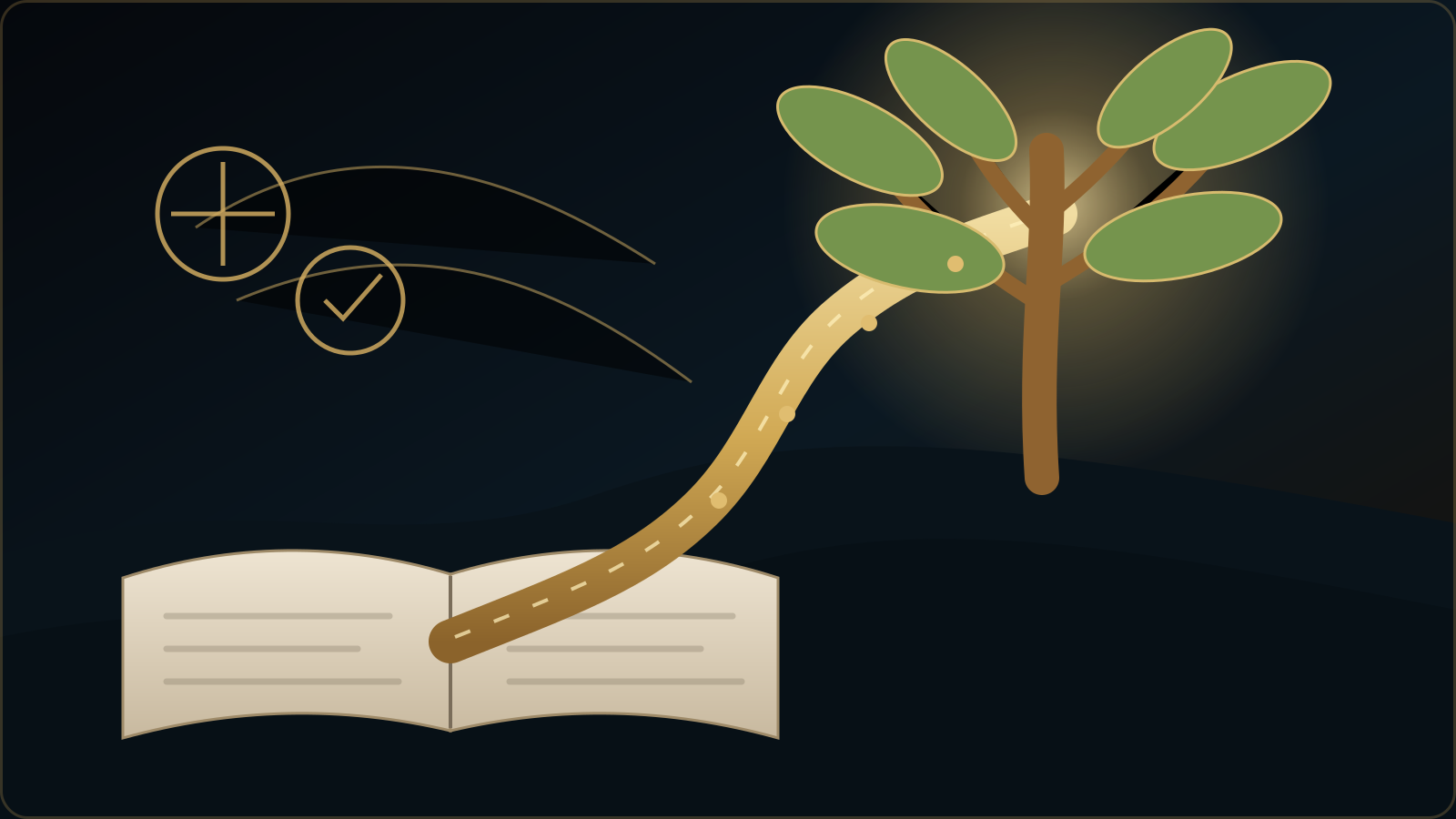
Whenever I put pen to paper to write about education, learning or upbringing, I think first not of books, theories or research, but of the young person sitting in a classroom with a thousand hopes, a thousand questions and, at times, a thousand anxieties.
Years of teaching, study, counselling and living alongside students have taught me that the greatest problem in education is not a shortage of information; it is the loss of meaning in learning. We sometimes become so absorbed in teaching people to know that we forget the more difficult task of helping them to become.
Knowledge is incomplete when it does not contribute to character. Intelligence, when detached from ethics, can become dangerous. Achievement, when reduced to ranks and certificates, can gradually distance a person from the self that education should have helped them discover.
I therefore see education, before anything else, as the formation of a worthy human being: someone capable of independent thought, kindness, perseverance, ethical clarity and responsibility extending beyond immediate self-interest.
A school is not a factory for producing marks. It is closer to a garden in which each person’s capacities should be given the conditions to grow. Flowers do not bloom in the same way. Trees do not bear the same fruit. Birds do not sing the same song. It follows that children and adolescents should not be forced into a single measure of worth.
Every human being is a unique sign within the book of creation. The task of the teacher and counsellor is not to compare these signs, but to learn how to read and understand each one.
I have never understood success as merely passing an examination. An entrance examination tests what a learner knows; life tests character, patience, hope, ethics, creativity, responsibility and faith.
For this reason, the responsibility of education is to cultivate the capable human being, not merely the successful student. Knowledge should become insight; insight should develop into character; and character should become visible in everyday conduct.
Family, teacher and counsellor
The family is the first school of the human being. No teacher can replace parental affection, just as no family can fulfil the work of the school alone. The future of children becomes stronger when home and school work not simply beside one another, but with one another.
A counsellor, likewise, is not merely a problem-solver. A counsellor is a trustworthy companion carrying a light so that the learner can see the path more clearly. The counsellor should not decide in place of the student; the deeper task is to help the student learn how to decide well.
Talent, effort and growth
I believe in talent, but not in a notion of talent that becomes an excuse for pride or despair. Talent is a seed. Effort is water. Discipline is light. Hope is the air that allows that seed to grow into a strong tree. Even the most fertile soil cannot perform a miracle for a seed that is never watered. No talent, therefore, reaches fulfilment without sustained effort.
Learning is not confined to school or university. A book, an experience, a failure, a journey, a conversation and even a period of silence can become a classroom. A person who stops learning has stopped growing, regardless of how many certificates may have been accumulated.
In a world changing with unusual speed, we need people who can think, choose, accept responsibility and live ethically. Much of tomorrow’s information may no longer need to be stored in human memory, but wisdom, conscience, ethics, creativity and the capacity for judgement will remain among our most valuable resources.
A final hope
I hope for a day when no student measures personal worth by marks alone; no parent compares a child with another; no teacher forgets that education is also the making of a human being; and no counsellor removes hope from the heart of a young person.
If this book helps even one person become more hopeful, more aware, more responsible or more compassionate, then I believe it has fulfilled a meaningful part of its purpose.
I remain hopeful about the future because I believe that the future will ultimately be shaped not by tools alone, but by informed, ethical and hopeful human beings. Few educational privileges are greater than having even a small part in helping such people grow.
Dr. Javad Rezazadeh Yazdeli